NextPCB’s useful distinction is the connection it presents between design analysis and manufacturing. Its homepage exposes a Gerber viewer, HQDFM tools, multilayer fabrication and assembly, with component sourcing and cable services alongside them. This is relevant for a team moving from layout completion to a controlled pilot build. The key question is which findings the tools detect and which still require an engineer’s judgment.
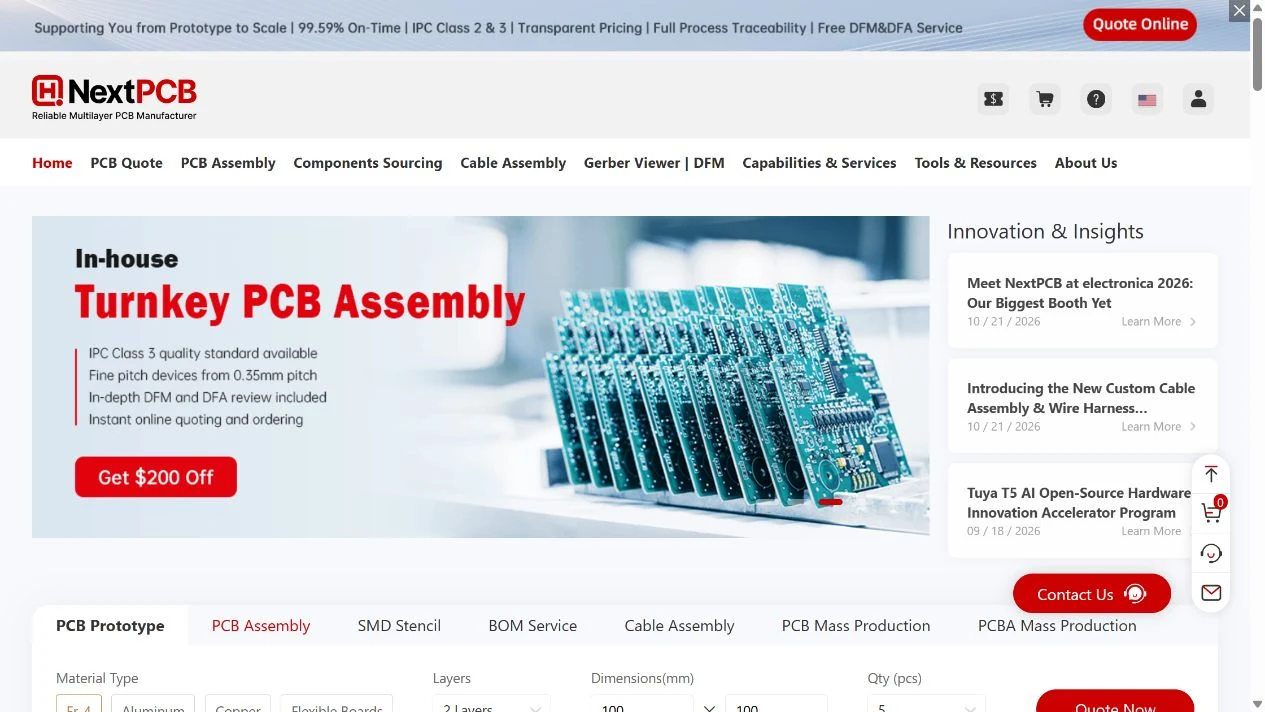
Editorial scope: PCBPit is a manufacturing service provider. This review assesses the supplier’s published offering and purchasing workflow; it is not a factory audit or a hands-on production test. Homepage checked and captured on 9 November 2026. Confirm project-specific capabilities, pricing and schedules in writing.
A DFM pass is not a functional design approval#
Geometric checks can help expose manufacturing risks before ordering, but they do not prove the schematic, power sequence or firmware. Treat a clean report as one input to release. Resolve reported issues against the selected factory process, then retain the approved file revision and responses. Our Gerber viewer is useful for visual file review; neither a viewer nor a screenshot substitutes for an agreed stack-up and fabrication drawing.
Multilayer capability must match the combined construction#
NextPCB lists standard and advanced boards, including HDI, rigid-flex and several material families. Individual maximum specifications should not be combined into an assumed buildable board. A dense controller might simultaneously need fine-pitch escape routing, filled vias and impedance-controlled layers. Ask for a reviewed stack-up and a clear list of approved exceptions. If a proposed change affects routing or pad geometry, update the controlled design rather than approving it only in an informal message.
Translate testing offers into measurable acceptance#
The homepage promotes assembly review and functional testing. Ask what is included for your quantity and product, and what you must supply. For an illustrative motor-control pilot, simply powering the board is not equivalent to validating current sensing, protection thresholds and communication under load. Specify a safe test fixture, firmware revision, test points and pass/fail limits. The PCB testing guide explains how visual inspection, electrical checks and functional tests answer different questions.
Shortlist NextPCB when design-for-manufacture feedback is central to your pilot. Compare PCBCart when configuration-heavy assembly and box build dominate, and JLCPCB when library-based ordering is the main preference. Use a small-batch release plan for all bidders, including PCBPit, so testing and sourcing responsibilities remain comparable.
Make the quotation comparable#
Use one controlled release pack for every bidder: Gerbers and drills, fabrication drawing, stack-up, assembly drawings, BOM and placement file where applicable. Separate board fabrication, parts, setup, assembly, testing and freight. Record the approved revision and all exceptions before paying. A low board price does not establish a low delivered cost, and an inspection list does not establish functional test coverage. Ask who supplies test fixtures, firmware and acceptance limits; agree how shortages, substitutions and failed units will be handled.
Questions buyers ask#
Does passing HQDFM prove the circuit works?
No. Manufacturing analysis and functional validation address different risks. Retain electrical design review and a product test plan.
Is functional testing automatically comprehensive?
No. Coverage depends on fixtures, firmware, stimuli and agreed limits. Ask for a written test procedure and report format.
Can advanced process limits be combined freely?
No. Material, copper, drilling and lamination interact. Obtain approval for the complete construction, not isolated headline values.
What belongs in a pilot release record?
File revision, resolved DFM questions, approved parts, test procedure and permission to proceed after first-article results.