If you’ve ever used a smartphone, connected to Wi-Fi, or marveled at satellite communication, you’ve indirectly interacted with a technology that relies on specialized printed circuit boards (PCBs).
Among these, Rogers PCBs stand out as a critical component in high-performance electronics. But what exactly are they, and why do engineers choose them over standard PCBs?
2. What Is a Rogers PCB?
A Rogers PCB uses one or more circuit laminates supplied by Rogers Corporation. These materials include several resin and reinforcement systems designed for RF, microwave or other demanding applications. Select a specific grade from its data sheet rather than treating Rogers as a single material or assuming every grade outperforms every FR-4 laminate.
Key Features of Rogers PCBs
- Low dielectric loss: Suitable grades can reduce dielectric dissipation in RF and microwave transmission lines.
- Controlled dielectric properties: Check the selected grade’s dielectric constant, test method, frequency and temperature dependence.
- Thermal options: Thermal conductivity varies by grade; a complete heat-flow design is still required.
- Low moisture absorption: Many grades specify low uptake, but the finished assembly still needs environmental protection where required.
Rogers PCBs are not a one-size-fits-all solution. Instead, Rogers Corporation offers a range of materials (e.g., RO3000®, RO4000®, TMM®) tailored for specific applications.
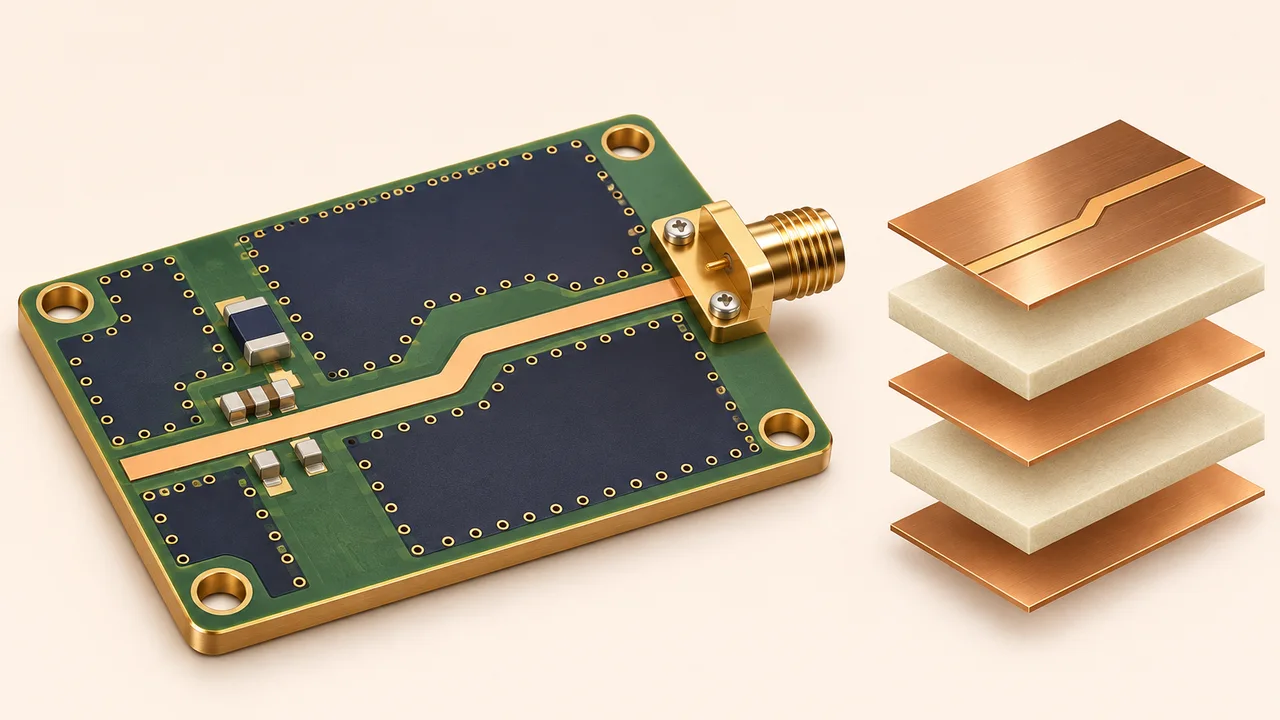
3. Rogers PCB vs. FR-4: What’s the Difference?#
To understand why Rogers PCBs matter, let’s compare them to standard FR-4 boards:In short:
- FR-4 is a broad family of glass-reinforced epoxy laminates. Its suitability depends on grade, signal path length, frequency and the allowable loss budget.
- A suitable Rogers laminate may offer lower loss or tighter dielectric control where the application needs it. Compare data under equivalent measurement conditions.
4. Materials Used in Rogers PCBs#
Rogers Corporation produces several high-frequency laminates. Here are the most common types:
a. RO3000® Series
- Material: Ceramic-filled PTFE (polytetrafluoroethylene).
- Key Benefits:
- Low-loss grades are available for microwave and millimeter-wave circuits, including automotive radar; verify the particular grade and frequency range.
- Selected grades offer controlled dielectric behavior over temperature; use the individual material data rather than a family-wide assumption.
- Applications: Satellite communication, millimeter-wave sensors, aerospace.
b. RO4000® Series
- Material: Glass-reinforced hydrocarbon/ceramic laminate systems.
- Key Benefits:
- Balances performance and cost.
- Many RO4000 grades use standard epoxy/glass processing; follow the grade-specific fabrication guidance.
- Applications: 5G base stations, RF antennas, medical imaging devices.
c. TMM® Series
- Material: Thermoset microwave materials.
- Key Benefits:
- Thermal conductivity is grade-dependent; consult the data sheet rather than assuming heat-sink-like behavior.
- Potential uses include power amplifiers and other microwave circuits with a suitable electrical and thermal design.
- Applications: Military radar, broadcast equipment.
5. Why Use a Rogers PCB? Key Benefits#
Engineers consider Rogers materials when their measured electrical, thermal or processing properties better meet a project’s requirements than the available alternatives.
a. Superior High-Frequency Performance
Higher frequency and longer interconnects can make dielectric loss, copper roughness and impedance discontinuities more important. There is no universal 1 GHz cutoff at which FR-4 becomes unusable. Select a laminate using the circuit’s loss budget, operating band and fabrication constraints.
b. Better Thermal Management
Some material grades can improve heat conduction compared with a particular alternative, but ceramic filler does not make the PCB a heat sink by itself. Evaluate component dissipation, copper, thermal vias, interfaces and cooling together before predicting temperature or lifetime.
c. Tight Impedance Control
Impedance describes the voltage-to-current relationship for an AC signal and includes reactive effects. Predictable dielectric properties help designers control transmission-line impedance, such as 50 Ω in many RF systems, alongside trace geometry and reference-plane spacing.
d. Durability in Harsh Environments
Moisture uptake, thermal expansion and material stability should be checked for the chosen grade. Space, radiation or chemical exposure requires application-specific qualification; a Rogers label is not a guarantee that the finished board will not degrade.
6. Where Are Rogers PCBs Used?#
Rogers PCBs power technologies that demand peak performance:
a. Telecommunications
- 5G infrastructure: Suitable materials can support RF and millimeter-wave circuits; select them for the actual operating band.
- RF antennas: Dielectric control and loss characteristics can support antenna and feed-network design in base stations and satellite systems.
b. Aerospace & Defense
- Radar Systems: Track aircraft or missiles with precision.
- Satellites: Selected circuit materials may be used in qualified RF assemblies; radiation, outgassing and temperature requirements still need verification.
c. Automotive
- ADAS (Advanced Driver Assistance Systems): Enable radar-based collision avoidance.
- Electric vehicles: Select materials for the specific circuit; an EV battery-management function does not automatically require a Rogers RF laminate.
d. Medical Devices
- MRI Machines: Transmit clean signals for accurate imaging.
- Surgical Tools: Support high-frequency energy delivery in minimally invasive procedures.
e. Consumer Electronics
- Routers: RF laminates may support antenna or RF-circuit requirements, but do not by themselves guarantee lower gaming or streaming latency.
- Wearables: Material selection can support RF design where needed; Bluetooth or Wi-Fi operation alone does not make a specialty laminate necessary.
7. Designing a Rogers PCB: Key Considerations#
Designing with Rogers materials requires careful planning:
a. Material Selection
Choose the exact grade for frequency, loss, power, temperature, copper profile and fabrication needs. For example, RO4835 is a hydrocarbon/ceramic material designed for improved oxidation resistance; its suitability should be checked against the complete specification.
b. Impedance Matching
Use simulation tools (like ANSYS HFSS) to calculate trace widths and spacing for target impedance.
c. Thermal Management
Use suitable copper areas, thermal vias and heat-sink interfaces for high-power components. Any metal-backed or hybrid construction must be agreed with the fabricator.
d. Manufacturing Challenges
- Drilling: Requirements depend on the laminate system. PTFE and thermoset materials can require different tooling and hole-wall preparation; follow the material supplier and fabricator guidance.
- Layer bonding: Hybrid Rogers/FR-4 builds need a compatible bonding system, lamination cycle and expansion behavior agreed with the fabricator.
8. Common Questions About Rogers PCBs#
Q: Are Rogers PCBs worth the cost?
A: They can be worthwhile if the selected grade provides the electrical or thermal performance the design needs. Compare the complete fabricated-board cost, loss budget and reliability requirements; FR-4 may remain the appropriate choice for many circuits.
Q: Can I solder components onto a Rogers PCB?
A: Yes. Use the laminate supplier’s and assembler’s approved thermal profile. Many RO4000 materials are compatible with lead-free processing; low-temperature solder is not a universal requirement.
Q: Are there alternatives to Rogers PCBs?
A: Yes. Other suppliers offer low-loss and RF laminates, including product families from Isola, Taconic and Panasonic. Compare specific grades, test conditions, processing requirements and availability rather than relying on brand rankings.
Q: Can hobbyists use Rogers PCBs?
A: Yes, if a fabricator offers the required material and the cost fits the project. Specialty materials may be unnecessary for a simple circuit but can be useful for RF prototypes and experiments.
9. The Future of Rogers PCBs#
Higher-frequency systems and smaller RF modules continue to demand lower loss, stable properties and reliable fabrication. Future material choices should follow verified data and producible stack-ups rather than assuming every emerging technology will use one supplier’s laminates.
10. Conclusion#
Rogers circuit materials are useful options for demanding RF and microwave designs. Their value comes from the properties of a chosen grade combined with appropriate layout, fabrication and assembly. They are not necessary for every circuit, nor do they replace system-level validation.
Whether designing radar, an antenna or a communication link, start with the signal and environmental requirements, select the material against those requirements and confirm the production process with the fabricator.