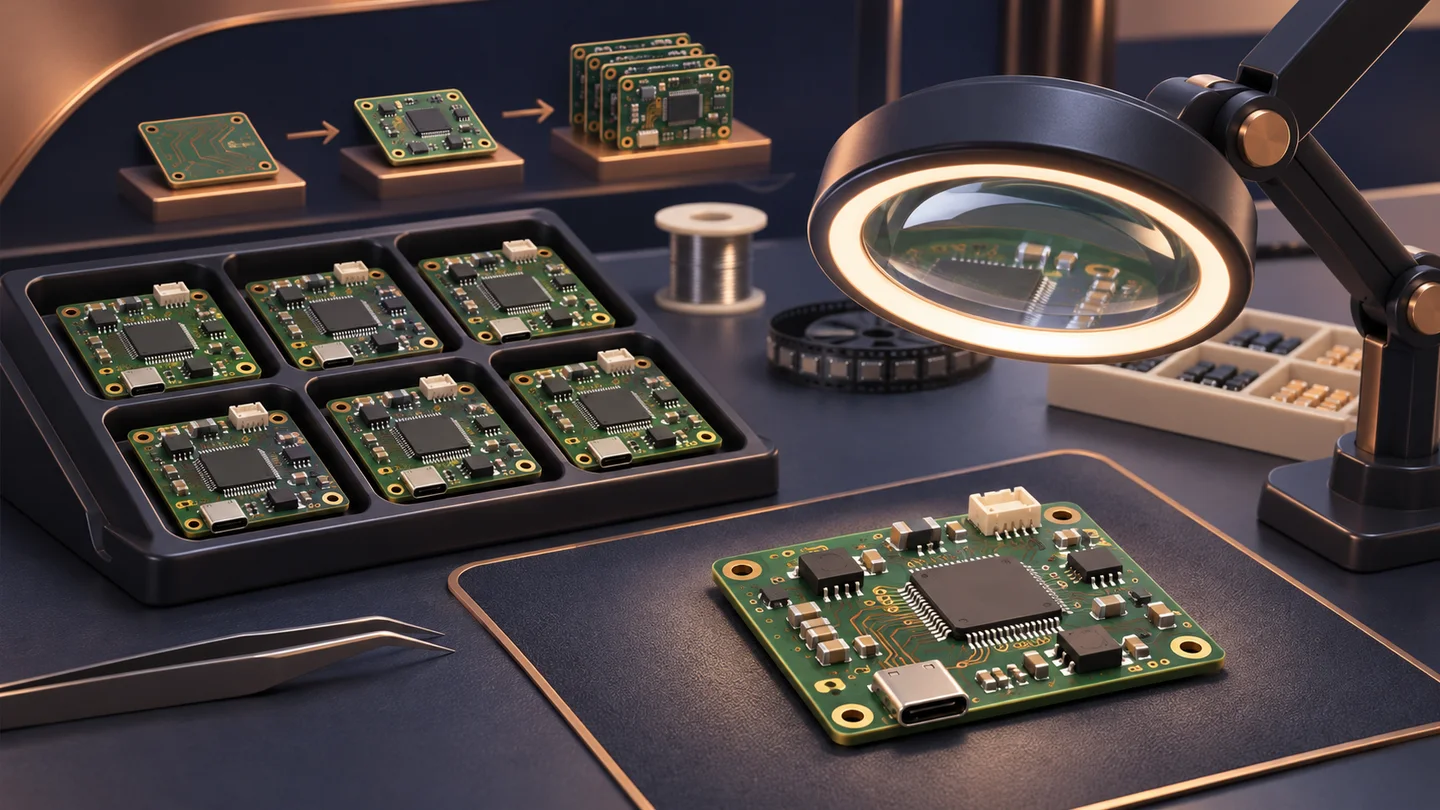
A working prototype is an important milestone. The next challenge is building several boards that behave the same way, arrive with the right components and can be reproduced without rediscovering every assembly decision. For a startup or a small engineering team, low-volume PCB assembly is as much a coordination task as a manufacturing task.
This guide explains what to prepare before requesting a quote, how to separate fixed and recurring costs, and where to place approval checkpoints. The aim is a controlled first build that leaves useful records for the next order, rather than a batch whose success depends on undocumented workarounds.
What Low-Volume PCB Assembly Means#
Low-volume PCB assembly means populating and soldering a limited batch of printed circuit boards. It can support engineering validation, pilot production, field trials or a specialist product with modest recurring demand. There is no universal board-count threshold: complexity, setup effort, component availability and the intended use matter alongside quantity.
A prototype primarily answers whether the design works. A pilot build asks whether the design, purchasing instructions, assembly process and test method work together consistently. A repeat production order relies on the approved records from those earlier builds. Decide which question your batch must answer before choosing its size.
Choose a Batch Around the Next Decision#
Start with the boards needed for electrical validation, firmware work, mechanical fit checks and external evaluation. Account separately for units consumed by destructive tests or retained as reference samples. A hypothetical team might divide a pilot batch among development, enclosure testing and customer evaluation; this is a planning example, not a recommended minimum order.
Increasing quantity can spread setup costs over more units, but it also commits more money to a design that may change. Ask for quantity options using the same board revision and test scope. Compare the cost of the complete build and the cost of a potential redesign, not only the quoted price per assembled board.
Separate Setup Costs from Repeat Costs#
A useful quote separates bare boards, components, assembly, engineering setup, tooling, testing, packaging and freight. Stencils, placement programming and a dedicated test fixture may create initial costs, although their reuse depends on the next revision and the supplier agreement. Component purchases may also include minimum pack quantities or agreed assembly attrition beyond the parts fitted to delivered boards.
Compare quotations on an identical scope. A lower assembly line item may exclude through-hole work, programming, functional testing or a special inspection. Before reducing cost, identify what each operation protects. Removing a required test or accepting an unreviewed substitute can move expense from the quote into debugging, rework or field failures.
Agree Who Owns Component Decisions#
In turnkey assembly, the assembler sources the agreed materials. With customer-supplied or consigned assembly, you provide some or all components. A mixed arrangement can be useful for a proprietary module or a long-lead device you already hold. Record the sourcing owner for every BOM line and agree how incoming condition, quantity, surplus stock and shortages are handled.
Do not treat matching values and package names as sufficient approval for an alternate. Voltage rating, tolerance, pinout, thermal behavior, lifecycle and firmware compatibility may differ. Identify who can approve a change, capture the proposed manufacturer part number, and record whether approval applies to one lot or future orders. The assembler should never have to guess what an empty substitution field means.
Prepare One Consistent Manufacturing Package#
Export fabrication and assembly files from the same released design revision. Include Gerber and drill data, board specifications, the BOM, pick-and-place coordinates and assembly drawings with clear polarity. Add programming files and test instructions when these are part of the order. Name the board revision in the package and identify any intentionally unpopulated parts rather than silently deleting them.
Reconcile reference designators, quantities, footprints and top/bottom placement between files. A correct BOM cannot compensate for coordinates exported from an older layout. If you change the design after quotation, send a complete replacement package and a concise change log; do not rely on a message that says only to use the latest attachment.
Use the PCB BOM guide to structure the component list, then review the assembly process to understand where each file is used. Keep the purchasing specification and the engineering release under the same revision control.
Use a First-Article Approval Gate#
Agree before production whether the assembler will hold the remaining batch after the first assembled sample. Define what you need to review, who signs off, and how quickly the team can respond. Photographs help confirm orientation and visible workmanship, but they do not establish electrical performance or reveal every hidden joint. Match the evidence to the risk.
First-Article Sign-Off Checklist
- Identity: PCB revision, BOM revision, firmware version and sample identifier match the released order.
- Assembly: fitted and unpopulated positions, pin-one orientation, polarity and connector direction are checked against the drawings.
- Verification: agreed inspection and electrical or functional tests have recorded results and explicit pass/fail criteria.
- Release: deviations, corrective actions, approver and approval date are recorded before the remaining build proceeds.
Choose Testing That Answers Your Product Risks#
Small quantities do not remove the need for an acceptance plan. Visual inspection and AOI address observable assembly features; X-ray can help inspect certain hidden joints. Electrical and functional tests answer different questions. A functional test needs defined power conditions, interfaces, firmware and expected outputs. See the PCB testing guide when selecting complementary methods.
Ask separately about the cost and ownership of test fixtures, programming adapters and scripts. For a changing prototype, a flexible test setup may be preferable to dedicated tooling that must be rebuilt after a layout change. Do not assume a quoted inspection automatically includes functional testing; agree the scope and required records in writing.
Plan Lead Time Around Dependencies#
Separate engineering clarification, material readiness, fabrication, assembly, testing and shipping in the project schedule. Some activities can overlap; others wait for approved information or parts. Ask when the quoted lead time starts and which conditions can change it. A fast assembly slot cannot resolve an unavailable component or an unanswered polarity question.
PCBPit provides dedicated 24-hour project follow-up for custom requirements. Use that contact to keep engineering questions, material decisions and first-article approvals in one traceable conversation. Around-the-clock follow-up is a communication service, not a promise of 24-hour manufacturing or delivery; production timing and inspection scope are confirmed for the individual project.
Before You Request a Small-Batch Quote#
- State the build purpose, requested quantity, target date and whether a first-article hold is required.
- Supply one released file package, including board specifications, BOM, placement data and assembly drawings.
- Identify customer-supplied parts, approved alternatives, no-substitution items and the person authorized to approve changes.
- Define testing, programming, traceability, packaging and the records needed for acceptance; ask what is excluded.
Make the Next Order Easier to Repeat#
Close the first build with a released BOM, approved deviations, inspection and test records, and a clear list of remaining issues. Retain an identified reference sample when appropriate. Before reordering, check component availability and confirm whether firmware, tooling, test coverage or the board revision has changed. A repeat order should reference a controlled build package, not merely an old purchase number.
Ready to discuss your pilot build? Send your quantity, current design files and verification requirements through the PCBPit project enquiry. We can review the custom requirements with you and clarify sourcing, assembly and approval responsibilities before the build proceeds.
Low-Volume Assembly Questions#
Is there a standard minimum order quantity?
No single minimum applies across all projects. Board complexity, component packaging, sourcing and setup requirements affect feasibility. Request confirmation for your design and quantity rather than assuming that a general small-batch label guarantees a particular minimum.
Can I supply only the critical components?
A mixed sourcing arrangement can be discussed. Identify the supplied parts in the BOM and agree packaging, quantities, incoming checks and shortage handling before shipment. Confirm compatibility and traceability requirements for every supplied device.
Does first-article approval replace batch testing?
No. First-article approval checks the agreed sample and setup evidence. It does not establish that every later unit is defect-free. Define the inspection and testing applied to the remaining batch, including the sampling or unit-level coverage required for acceptance.
Can a small batch use the same process as later production?
It can share materials, assembly methods and acceptance requirements, but tooling, panelization or testing may change with volume. Record the differences and revalidate affected features when scaling. A successful pilot is useful evidence, not automatic approval of every future process change.
Image note: the cover is a conceptual engineering illustration, not a photograph of a PCBPit production line.