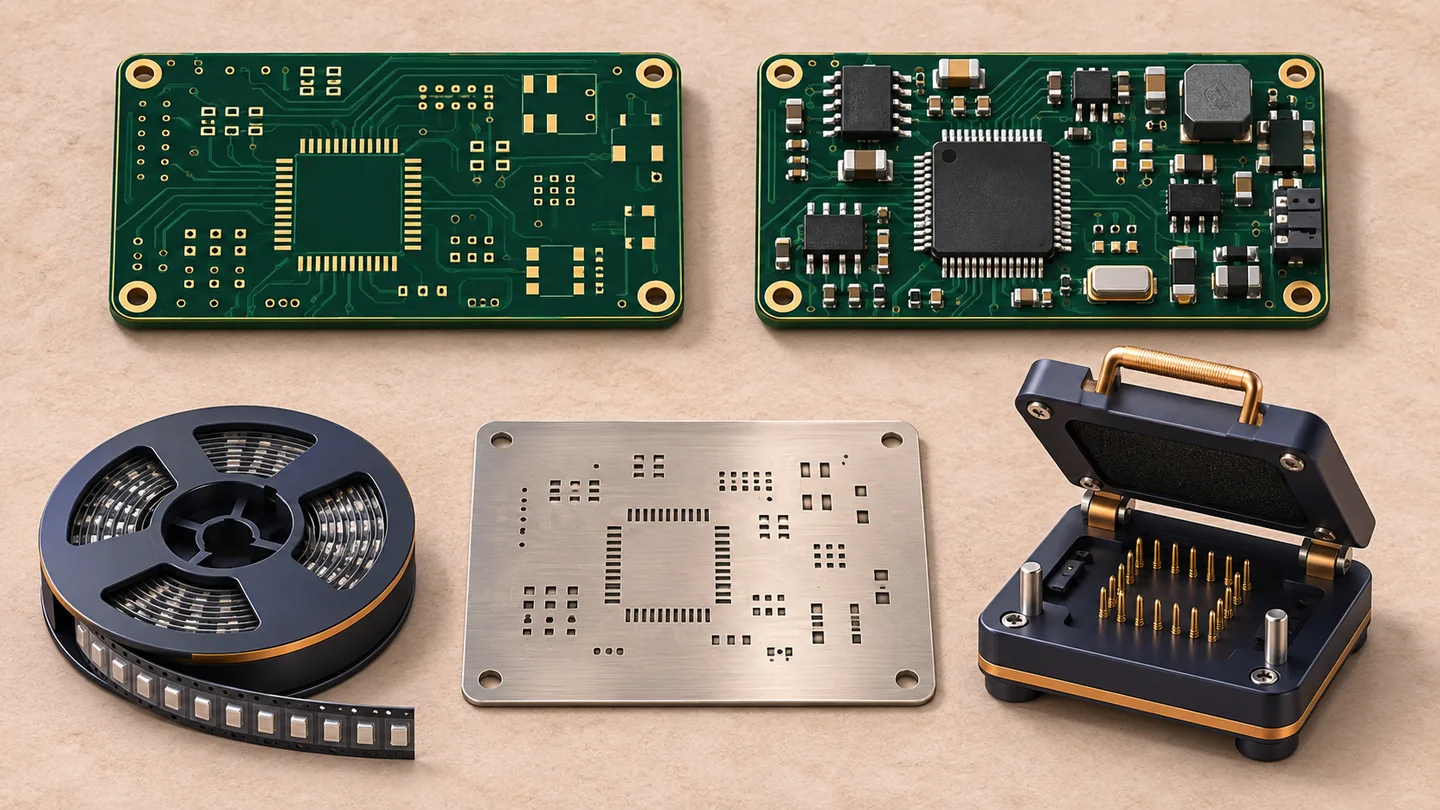
A PCB assembly quote is a price for a defined build, not simply a price per solder joint. Two offers for the same board can cover different component purchases, setup work, inspection and delivery responsibilities. Before comparing the totals, establish what each supplier will actually deliver and which engineering decisions are still open.
This guide separates PCB assembly cost into recurring production, order-level preparation and non-recurring engineering. It includes a deliberately hypothetical cost model, a scope-comparison table and a release checklist. There are no supplier price claims: the useful result is a quotation you can explain, approve and compare again when the design or quantity changes.
Start with the complete delivered assembly#
Separate the bare PCB from the assembled product. Board fabrication covers the laminate, copper, holes, surface finish and other specified board processes. Assembly adds purchased parts, material handling, soldering and the agreed verification. Programming, coating, enclosure installation or packaging can be additional operations; do not assume that the word “turnkey” automatically includes them.
State whether the quotation is for boards started, boards completed or accepted assemblies delivered. Ask how replacements, rework and unused components are handled. A low purchase total can become expensive when the team must separately source missing parts or repeat an omitted test. The low-volume assembly guide helps define approval points for a pilot build.
Separate one-time, per-order and per-board costs#
The table describes a purchasing model, not a universal invoice format. Suppliers may bundle several rows into one charge. Request the assumptions behind each line so an apparently free setup does not hide a different unit price, an excluded operation or a charge that reappears on the next order.
| Cost item | Typical cost behaviour | Confirm before approval |
|---|---|---|
| Bare boards | Quantity-dependent fabrication plus possible tooling | Stack-up, finish, panel and delivered quantity |
| Components | Consumed parts plus purchase and surplus commitments | Exact MPNs, pack quantities, substitutions and ownership |
| Assembly setup | Often incurred per production run | Machine preparation and repeat-order charges |
| Placement and soldering | Recurring work, affected by process complexity | Both sides, manual work and special handling |
| Stencil and fixture | Initial tooling; revisions may require replacement | Ownership, storage and reuse conditions |
| Inspection and testing | Test development plus recurring execution | Coverage, limits, records and failure handling |
| Delivery | Order-level packaging and logistics | Shipping, taxes, duties and delivery terms |
Component purchasing can outweigh placement savings#
A BOM line is not a complete purchase instruction unless it identifies the manufacturer part number, quantity per board, population status and approved alternatives. Package size alone does not specify voltage, tolerance, temperature rating or lifecycle requirements. Consolidate genuinely interchangeable parts only after engineering approval; a cheaper substitute that needs a redesign or qualification is a different commercial decision.
Purchased quantity may exceed fitted quantity because of packaging, minimum purchases or agreed process allowance. Ask who owns the excess, whether it is returned or stored, and whether the next quote credits usable stock. Customer-supplied components also need receiving, quantity checks and handling; they do not make material management disappear. Use the PCB BOM guide to make these responsibilities explicit.
Process complexity changes the work behind the quote#
Placement count matters, but it is not the only measure of effort. A second populated side may require another print, placement and reflow sequence. Through-hole connectors may require selective, wave or manual soldering depending on the assembly. Heavy parts, restricted access and components with special handling instructions can change the process route even when the total component count barely changes.
Fine-pitch and hidden-joint packages can require additional process review and suitable inspection. Do not replace a required package merely to simplify assembly: evaluate routing, thermal performance, sourcing and verification together. Similarly, panelization may improve handling but can introduce tooling, edge-clearance and depaneling requirements. Review the actual assembly process rather than assuming a fixed fee for every board design.
Tooling and testing: distinguish development from execution#
A stencil or test fixture may be reusable, but reuse depends on the revision, condition and supplier agreement. Ask whether an unchanged reorder uses existing tooling, who stores it and what changes require replacement. Production setup can still recur even if the physical tooling is reused. Treat fixture development, test software and programming preparation as separate deliverables with defined acceptance criteria.
Inspection and functional testing answer different questions. A visual inspection does not demonstrate every operating mode, and a short power-on test does not replace a defined acceptance procedure. Specify coverage, test time, fixtures, firmware, pass/fail limits and records. The PCB testing guide helps match the test plan to the product risk; do not remove necessary checks solely to reach a lower headline price.
A hypothetical quantity comparison without invented prices#
For planning, write the batch total as engineering and tooling + run setup + quantity × recurring board cost + order logistics. Divide by the number of accepted assemblies only when the commercial basis and acceptance quantity are clear. This is a simplified accounting model: component price breaks, minimum purchases and extra process runs can change the terms as quantity changes.
Assume, only for illustration, that an unchanged design is built in one run and setup effort stays identical. At 20 boards, each board carries one twentieth of that setup; at 100 boards it carries one hundredth. The setup allocation per board is therefore one fifth as large. This does not mean the complete unit price falls by 80%: components, fabrication, assembly and testing remain, and the total cash commitment generally increases.
Ask for quantity breaks against the same revision and test scope, then compare both total cash and unit price. For a design that may change after evaluation, buying more can create obsolete stock. Compare a pilot followed by a repeat order with a single larger order, including a second setup and possible fixture changes. The cheapest unit price is not automatically the lowest project cost.
Reduce avoidable work before reducing verification#
First resolve mismatches between the Gerbers, BOM, placement file and assembly drawing. Mark do-not-populate positions consistently and freeze a single revision package. Then review approved sourcing alternatives and process simplifications with engineering. Request the cost effect of each change separately, including any redesign and validation work, so savings are not counted before the change is proven acceptable.
Do not substitute a cheaper board material, remove traceability or shorten functional testing without checking the product requirements. These choices change the delivered specification. A useful cost review distinguishes unnecessary work from work that controls a real failure risk. For custom builds, ask PCBPit to quote the approved baseline and identify optional engineering changes separately.
A checklist for comparable PCB assembly quotations#
- Send one revision of Gerber and drill files, BOM, placement data and assembly drawing; identify quantity breaks and do-not-populate positions.
- Define component purchasing, approved alternatives, surplus ownership and treatment of customer-supplied material.
- Specify inspection, programming and functional tests, including acceptance limits, records and responsibility for failures.
- Ask for tooling, per-run setup, recurring production and logistics separately, plus quote validity and conditions for an unchanged reorder.
Submit the complete package through the project quotation form, or review the PCB assembly service to clarify the build scope. If a requirement is undecided, flag it rather than silently choosing the cheapest assumption. A clearly qualified estimate is more useful than a precise-looking total for an incomplete specification.
PCB Assembly Cost FAQs#
Why is a small batch expensive per board?
Setup, engineering review and tooling are spread across fewer boards. Small component purchases can also have different economics from larger purchases. Ask for fixed and recurring charges separately; the balance depends on the design, sourcing and test scope, not a universal small-batch multiplier.
Does supplying my own components always reduce cost?
No. Compare your purchasing and shipping costs with the supplier’s complete sourcing charge, then include receiving, packaging suitability, shortages and surplus handling. Consignment may be useful for controlled stock, but responsibilities and replacement arrangements still need agreement.
Will the second order avoid all setup charges?
Not necessarily. An unchanged stencil or fixture may be reusable, while machine setup and production preparation can recur. Revised footprints, panel layouts, firmware or test requirements may need new work. Confirm what is retained and quote the repeat order against the exact approved revision.
Can I estimate assembly cost from the BOM alone?
A BOM supports component costing but does not fully describe board construction, placement, soldering access or testing. Supply fabrication and placement files, assembly instructions, quantity and acceptance requirements. A preliminary estimate should identify missing information and its assumptions before it is used as an approved budget.
Should I choose the lowest total quotation?
Compare totals only after aligning delivered quantity, component approval, test coverage, tooling, freight and commercial terms. Ask suppliers to explain exclusions and optional work. A higher quoted total may include work another supplier leaves to your team; a lower total may be appropriate when the scope genuinely matches.