The choice between turnkey and consigned PCB assembly is primarily a choice about purchasing responsibility. Who buys each part, who confirms that it can be used, and who acts when a reel is missing? Decide those points before comparing quotes. The cheapest assembly line item can hide a large amount of procurement and coordination work for your team.
This guide compares three sourcing models and gives a responsibility matrix, decision scenarios and a first-order handoff checklist. It does not assume that any model guarantees lower cost or faster delivery. The agreed statement of work controls the actual scope, including bare-board fabrication, inspection, programming and functional testing.
Three sourcing models, with boundaries to agree#
In full turnkey assembly, the assembly provider purchases the agreed components and coordinates the contracted build. You still supply the design, exact part requirements, approval authority and acceptance criteria. Turnkey does not transfer product-design responsibility or permit unapproved substitutions. Confirm whether the quote includes the bare PCB and every required test rather than inferring that from the service name.
In consigned assembly, the customer supplies the agreed material and the assembler performs the contracted assembly work. Define whether that material includes bare boards, all components or only specified items. Your purchasing team must deliver a usable, traceable kit—not merely enough nominal pieces on a spreadsheet. Incoming count and condition checks still need a named owner and an exception process.
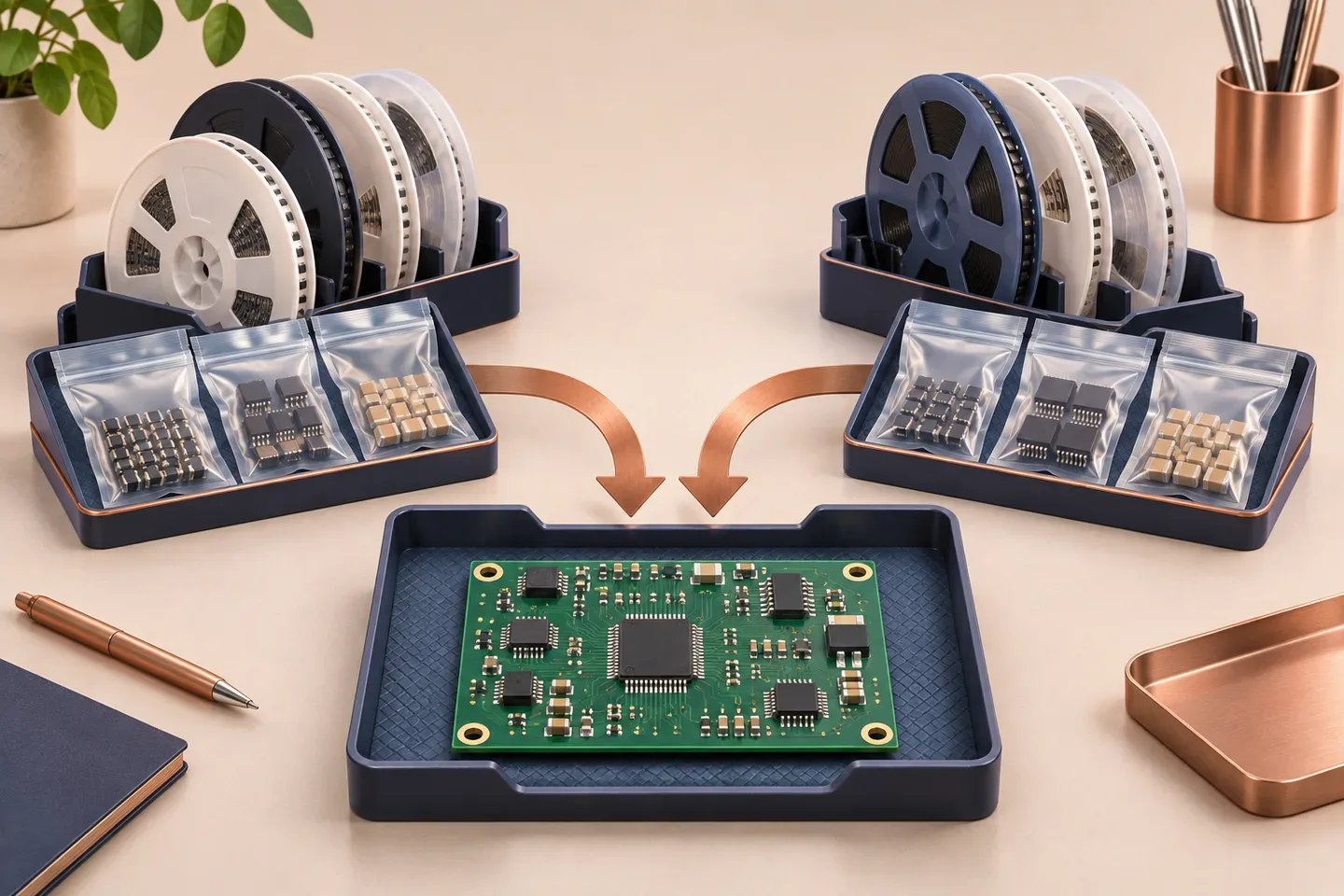
Partial turnkey combines the two: the provider buys some BOM lines and the customer supplies others. This is useful when you already hold an expensive or restricted part, but the split must be explicit for every line. Maintain one BOM with a sourcing-owner column, required quantities and approved manufacturer part numbers. Use the PCB BOM guide to make the purchasing data unambiguous.
A responsibility matrix for the purchase order#
Treat this matrix as a discussion template, not a substitute for the contract. “Customer approval” means a named engineering or purchasing authority. Receiving inspection establishes the agreed acceptance checks; it does not automatically prove authenticity, electrical performance or every hidden defect. Specify any additional traceability or testing evidence before ordering material.
↔ Swipe horizontally to compare all columns
| Decision | Turnkey | Partial turnkey | Consigned |
|---|---|---|---|
| Buy components | Provider, agreed BOM | Owner assigned per line | Customer, agreed kit |
| Approve alternatives | Customer approval | Same approval for all lines | Customer approval |
| Resolve a shortage | Provider proposes; customer approves changes | Assigned buyer plus shared readiness log | Customer replenishes or approves a revised build |
| Receiving checks | Agree checks and evidence | Apply the same acceptance rules | Assembler checks against the agreed kit |
| Surplus and traceability | Agree ownership and records | Record ownership per line | Reconcile customer stock; agree return or storage |
Substitutions, shortages and usable quantities#
Do not approve an alternative because the package looks similar or the distributor calls it equivalent. Review electrical ratings, tolerances, footprint, temperature range and any software or qualification dependency. Record the approved part number and affected BOM revision. For a partial kit, the same approval rule applies regardless of who paid for the component.
Ask the assembler for the quantity and packaging required for each line, including setup and expected handling losses. There is no safe universal extra-percentage rule for every package and machine. Reels, trays and cut tape may have different handling requirements. Identify moisture-sensitive parts and provide available storage/exposure information; follow the component instructions and the agreed process instead of prescribing arbitrary baking conditions.
When material is short, agree whether to wait, buy an approved replacement, build a smaller quantity or hold a specific operation. None of those decisions should happen silently. At completion, reconcile received, used, damaged and remaining quantities. Define whether surplus is returned, stored for a named repeat build or disposed of with authorization, including storage duration and charges.
Compare total cost and the actual production start#
Compare quotations using the same board revision, quantities, approved parts and test scope. Separate material, purchasing fees, setup, assembly, inspection, fixtures, shipping and surplus commitments. In consigned work, include your own purchasing labor and inbound shipments. A part already in your stock is not automatically free to the project: its availability, condition and replenishment still matter.
Distinguish the purchase-order date from the date a complete, accepted kit and approved files are ready. Material availability, incoming discrepancies and pending engineering answers can delay that readiness point in any sourcing model. Ask for a schedule tied to explicit prerequisites. For small first runs, the low-volume assembly guide explains how to stage approval before committing to repeat builds.
Three illustrative project decisions#
These are generic planning scenarios, not customer projects or measured results. A startup without a purchasing team may prefer turnkey for a stable BOM, provided it retains fast engineering approval of exceptions. The key question is whether a named person can answer sourcing queries promptly; outsourcing purchasing does not remove that dependency.
A team holding an allocated processor but lacking common passives may choose partial turnkey. Assign the processor to customer supply and the remaining lines to the provider, with one shared readiness list. A mature purchasing team with qualified stock and reliable kitting may instead choose consigned assembly. That team must still confirm packaging, excess quantities and incoming acceptance before shipping its kit.
First-order handoff: four confirmation points#
- Before quoting: freeze the revision, identify the buyer for every BOM line and define the test and traceability scope.
- Before purchasing: approve alternatives, non-cancellable commitments, quantity breaks and responsibility for surplus.
- Before assembly: reconcile the accepted kit with the released BOM and resolve shortages or discrepancies in writing.
- Before closing the order: obtain agreed inspection/test records and reconcile remaining customer-owned material.
For a PCB assembly enquiry, state the preferred sourcing model and the items you already hold. Ask the project contact to confirm each of these checkpoints with the responsible engineering or purchasing person. Continuous follow-up is useful when it closes a specific decision; it should not be presented as a guaranteed manufacturing turnaround.
Turnkey and consigned assembly FAQs#
Is turnkey assembly always cheaper?
No. Compare total delivered cost for the same BOM and scope, including purchasing effort, material, setup, inspection, freight and surplus obligations. Turnkey may reduce internal coordination, but the outcome depends on the actual parts and commercial terms.
Can I supply only one critical component?
That is a partial turnkey arrangement if the provider agrees. Identify the exact BOM line, quantity, packaging and arrival requirements. Confirm who checks it on receipt and how a shortage or unusable part affects the build release.
Who approves substitute components?
Use the approval authority named in the order, normally with design engineering responsible for technical suitability. Record the exact approved substitute before purchase or placement. Paying for the part does not by itself authorize a design change.
How many extra customer-supplied parts are needed?
Obtain a line-by-line requirement from the assembler. Package, feeding format, setup and handling influence the usable quantity. Do not rely on a single percentage for every item; agree treatment of expensive parts and remaining stock explicitly.
Does consigned assembly include testing?
Only the agreed scope determines that. Specify inspection, electrical or functional testing, programming, fixtures and records separately from the sourcing model. Supplying components neither guarantees nor excludes a particular test service.